Last month I shared some background on the listening and research journey the Foundation has been on for the past 18-24 months.
The journey I refer to includes the 100+ conversations with community members, and the various research and data gathering projects we took on here at the Foundation, to make sure we could more deeply understand what we heard in those conversations.
That work led our Board to a clarified vision for our role as an institution, categorizing our work into 4 compelling focus areas.
These 4 areas are important to understand, as they represent critical aspects of our community that need the most support from our unique role as a “funder.”
Our role as a funder – an organization that provides funding – specifically requires us to “exist in perpetuity” – or, forever.
The pressure of being required to “exist forever” comes with 2 big responsibilities.
First, we have to take care of our resources. This means our endowment and our donor-funds. Altogether, that gives us 120 (and growing) separate funds that we must invest, grow, and give (through grants and scholarships) in ways that can have the most positive impact for the most people in our community.
Second, we have to take on the most challenging issues our community faces. These are the challenges that exist beneath the surface but impact daily life.
In short, we must understand, and then confront, the biggest, most complex and challenging issues our community is facing.
Over the next 4 months my plan is to share with you a more in-depth view of our 4 primary areas of focus as a Foundation, and how they connect with our role as a funder.
To understand our first area of focus, let’s start with a story.
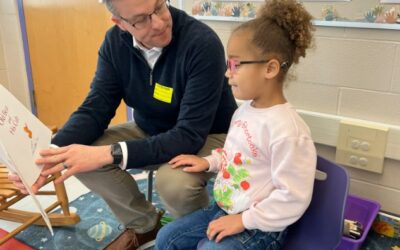
Remember your first day of Kindergarten?
I barely remember it, with just “flashes” of images coming to mind.
But you know who always remembers your first day of Kindergarten?
Your teacher!
Close your eyes and try to crawl into the mind of that teacher. Imagine the cubbies with 20 kids’ names taped on them, the multi-color rug for circle time, the tiny desks that seem impossible to fit in, and of course the door… decorated for the first day with a fun “sky” theme where every kid has their name in a cloud.
You watch as the little ones walk through the door, excited and bright-eyed!
This is an ideal experience, right?
The honest experience is that while some kiddos walk through the door excited and bright-eyed, 16 of those 20 kids, you notice, are having a hard time tying their shoes. Or they can’t zip their coat, or stand in a line. Or they can’t calm themselves down if someone takes their toy, and their tantrum is a distraction for everyone.
The list of challenging behaviors can go on and on.
And while it might be easy to rationalize that behavior as “typical kid stuff” I can assure you – based on nearly 2 years of research and meetings with experts in education – these behaviors are not just “typical kid stuff” from a 5- or 6-year-old child.
These challenging behaviors are barriers. Barriers to learning, building friendships, and growing into the type of community member you hope is your neighbor one day!
Looking at the class again through the eyes of the teacher, you know you have to help with basic behavior before you can start teaching the material… before students can extract the most value out of the classroom environment that’s been designed for their success.
These barriers are clear and present in our community.
We know this because 22.8% of our kids showed up to kindergarten demonstrating readiness for kindergarten… roughly 4 out of 20 kids.
I have written about this before, but as a refresher the “demonstrating readiness” language is the language from the Ohio Department of Education and Workforce’s Kindergarten Readiness Assessment.
This assessment is administered in the first few weeks of a school year and is used by the state to determine the level of preparation kids have to be successful in school.
So if that 22.8% number surprises you – good. It should.
Frustratingly, past data show that some of the 77.2% of kids who are not ready for kindergarten (but required to attend based on their age and state law) will not graduate high school on time. We know this already – years before they get into high school – because the data prove it.
It also means many of the kids will struggle with the third-grade reading requirement, 8th grade algebra, and more. The connection between kindergarten readiness and student on grade-level achievement is proven.
As the saying goes “if you start behind, you stay behind.”
For me, I start dreaming of a community where 50% or 75% of our youngest learners show up demonstrating readiness. In that community, our school district can be exactly the same as it is now, but student achievement and grade-level academic performance will be through the roof!
To make that dream come true, however, we have to start building solutions to address this complicated challenge.
The solution to this is not a quick “waving of a magic wand,” either. (Wouldn’t that be nice???)
The solution requires reassessing how we, as a community, support our youngest learners and their families. At least, that’s where we are starting our work this year, now that we recognize the challenge we’re facing.
This is just our first of 4 focus areas. As you may guess, we have a lot of work to do.
I hope you’ll reach out to talk about how you can help.
In Community,
Josh Gordon